
.svg)

Key takeaways
Last week I was listening to Minal Mehta, Head of Product at YouTube, she mentioned how birds use "drafting" to travel long distances with ease. This triggered curiosity in me. Fashion Demand Forecasting is also a long journey to realize the outcomes. The journey is getting more challenging by the day. How do we fly light instead of riding heavy?
Why Birds Fly V-Shape?
Researchers like Steve Portugal and Johannes Fritz studied birds migrating with sensors to understand why and what of the drafting. They realized the birds did something amazing.
When the birds flap their wings, they create an upwash and downwash of air vortex.
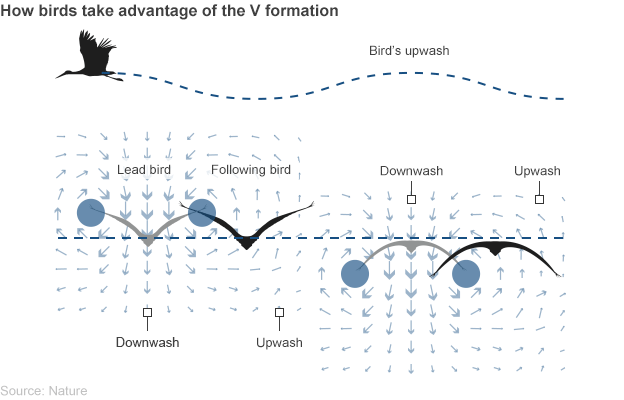
Upwash and Downwash Of Birds Flap
As the birds' flap, they make use of the up-lift created by the previous bird and this makes each follow the other. This reduces the energy required to fly. They arrange in a way the right tip of the wing matches the left tip of the previous bird (in the left side of the V). The reverse is true for the right side of the V. An analysis of the heartbeat showed the ones in the back have less heart rate than the ones in the front.
There is more to this. The birds swap their positions, and even the leader is not constant. They adjust to their new positions quickly. There are some birds who like to be on the left and there are some who are comfortable being on the right side of the formation.
Read this National Geographic article to know more about the amazing nature's trick.
There is so much we can learn from this including leadership. We will focus on how brands and retailers can solve the challenge in fashion demand forecasting using this nature's principle.
How To Fly Light In Fashion Demand Forecasting?
Current Status Of Fashion
Fashion cycles are long irrespective of whether the lead time is few weeks or few months. The mind to feedback cycle is a long journey like the migration of the birds.
How do we find the lift and the North Star of the destination? For any business and for fashion, the North Star is always a consumer. It is easy to say but difficult to understand consumer tastes over time and stay relevant. Consumer demand has changed over time. Yet, the way the industry has been researching, designing, buying, planning and distributing to meet the consumer demand has not changed over the years.
Current State Of Solution
Even the data-driven tools available to spot trends, analyze the market are supply-driven. Data in itself is not good unless we remove the noise. We covered the noise and signal in data in this article. The effect of noise shows up in the supply-demand gap and the full price sell-through brands are achieving. No wonder why there is so much oversupply.
A New Thinking
We need a paradigm shift in thinking, vision and then an execution plan to transform the situation. There is a misunderstanding of Fashion Demand Forecasting. The prevailing practice is fashion supply forecasting.
This made us invent Demand Science® in Stylumia. We wrote an article recently about Demand Science and how it is a paradigm shift in demand forecasting. The article also covers the current state of fashion retail and transformation. You can read the full article here.
A Paradigm Shift In Fashion Demand Forecasting
While you are choosing tools and solutions for your future of demand forecasting and trend forecasting, be very careful in asking the question "Is this tool demand-driven, consumer-driven or supply-driven?"
It is important for you to distinguish the solutions. Are they providing an Upwash or a Downwash?
Demand is not public information. We need to derive True Demand. Stylumia's proprietary True Demand engine solves this fundamental challenge. The Consumer Intelligence Tool (C.IT) provides you with the North Star for drafting through the journey.
This is just the starting point of the long journey. We say " There is no bad product when we buy the right quantity".
What this means is getting the right quantity is equally important. Quantitative demand forecasting at various levels of the business hierarchy is thus critical. Traditional prediction models fail in fashion considering the aesthetic and visual nature of the products. Also, the data used is largely internal. You will not be able to predict what you have never made before. This is a fundamental challenge. Stylumia addresses this challenge using a systemic view of the value chain. We bring in the outside-in consumer demand signals, combine them contextually with the brand's data to make relevant predictions. An ensemble machine learning model with computer vision and NLP (Natural Language Processing) powers Stylumia APOLLO. APOLLO helps predict pre-season and in-season demand.
The last mile is distribution. The localization of merchandise understanding taste of each channel, store including online is critical to meet true demand. Stylumia Store.Y solves this challenge.
In Conclusion,
We are at an important juncture in the transformation of the fashion industry. In particular, post-covid. You have an amazing opportunity to create the right drafting for your brand's journey ahead.
Like Jeff Bezos says always, keeping the consumer at the center helps go long term. Also, it is important to confront the current reality while being optimistic about the future. It is the Stockdale Paradox. Here is an article from Harvard Business School on this paradox and its application.
Wishing you all a wonderful 2021 with tons of upwash and draft for your business as you navigate the future.

.jpg)
.jpg)