
.svg)
Key takeaways
Customer expectations are changing faster than ever before. Retail operation and execution have changed. However, product and inventory decision making remains unchanged for years. Therefore, there is a need for a paradigm shift in the approach to the fashion business. This paradigm shift is the invention of Demand Science® for fashion.
State Of Fashion Retail

What has not changed in fashion retail over the years?
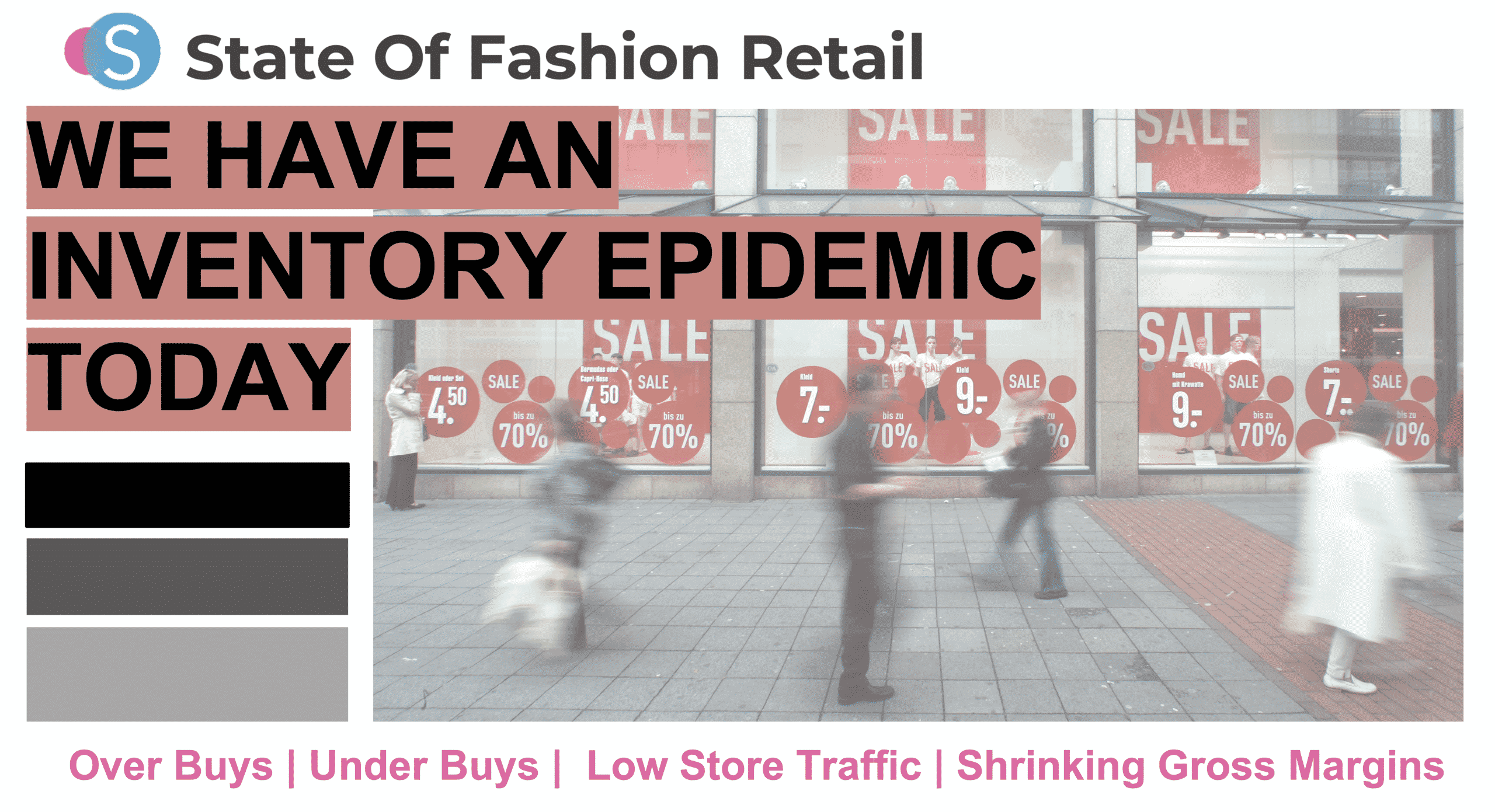
We addressed how convenience is a huge blinder in our previous edit, "The tyranny of convenience, a blinder to true demand forecasting". As a result, we are seeing an inventory epidemic. In the post covid world, a lack of precision demand forecasting can break a fashion business. The byproducts of poor demand forecasting are overbuys, underbuys, low store traffic, and shrinking gross margins.
Fashion Inventory Epidemic
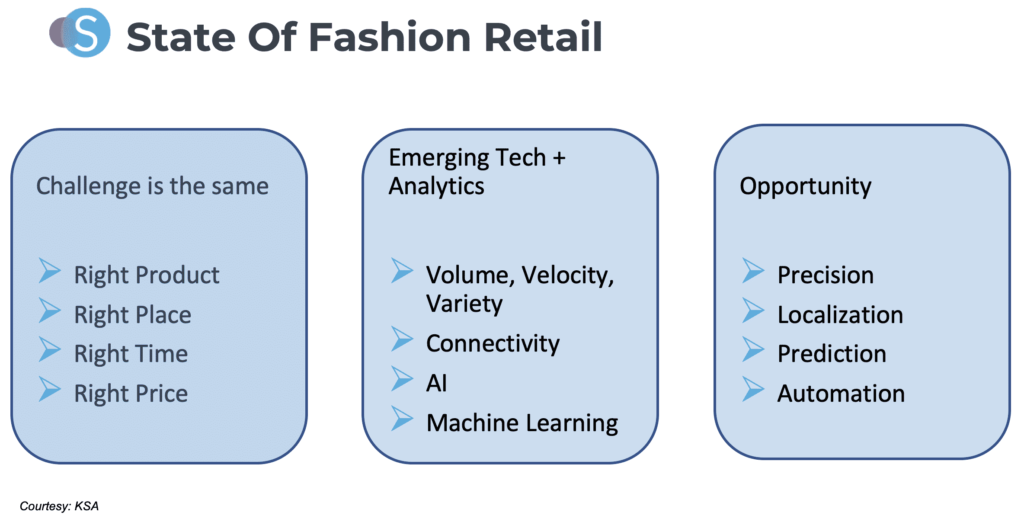
The retail challenge has remained the same for decades. The challenge is in getting the right product at the right place at the right time and the right price. With the technology available today we are presented with an opportunity to transform the precision, localisation, prediction and automation of the key decisions in design, buying, planning, allocation and pricing.
Fashion Retail Opportunities With Technology | Courtesy KSA
State Of Fashion Design, Buying, Merchandising & Allocation
Let's take a look at the status of decision-making across design, buying, merchandising, and allocation.
Firstly, the approach to design is not seeing fundamental change over the years. Some of the key processes are research, storyboarding, prediction, and then designing. For instance, fashion research is growing beyond traditional travel, web-based search to retail data. There is a notion in this area that data is good.

Fashion Design Processes Over The Years
The key issue here is the data used has a lot of noise and very low signal, resulting in inaccurate decisions in design, buying, and merchandising. There must be a new way to eliminate data noise. You can read our detailed article on the fashion data noise here.

Data Is Not Always Good
Secondly, in buying, consumer research and expert panels facilitate new style prediction. The competitive analysis and white space spotting are driven by supply signals. The prevailing prediction models use product attributes. This is with the assumption that attributes can explain fashion products. However, fashion being an art, can not be described in textual attributes.
Thirdly, while allocating productions to channels and stores, even the sophisticated store clustering and allocation algorithms do not consider consumer affinity to products. Here again, there is a huge opportunity to understand True Demand of consumers at the level of a store/location.
Above all, the job of designers, buyers and allocators are getting harder than ever before.
A New Thinking | The Demand Science For Fashion

The New Thinking In Fashion Demand Forecasting
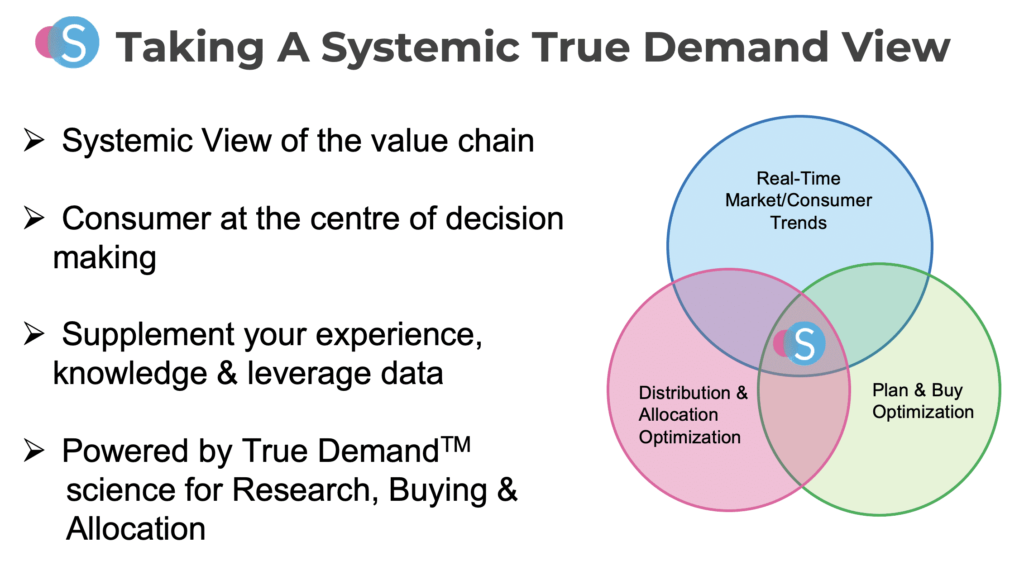
Hence, we invented Stylumia's demand science for fashion. At the core is Stylumia's proprietary True Demand engine. This Demand Science drives design, planning, buying and merchandising, and allocation decisions. The True Demand engine is powered by proprietary machine learning, computer vision, and AI algorithms. For example, the True Demand engine derives consumer taste and store taste from the omnichannel data of the brand along with true consumer demand signals from the market.
The Demand Science for fashion business takes a systemic view of the value chain. The system encompasses the entire cash to cash cycle of the value chain, including consumer research. You can check more details about Stylumia's solutions here ( C.IT, Apollo, Store.Y).
Systemic View Of Fashion Value Chain With True Demand
It is important for fashion brands and retailers to empower the keys roles with consumer-driven intelligence to make informed decisions with speed and precision. This is a way to eliminate significant economic and environmental wastage.
It is time to revisit your processes and technology solutions and ask the following fundamental questions,
1 - Are you guided by data noise and subjectivity in trend research?
2 - Are you exploding with data and not making the best use of them in planning, buying, merchandising & pricing?
3 - Are you able to localize assortments using the store-specific taste of consumers?
The cost of taking decisions on the technology solution on convenience is extremely expensive.
Choose wisely.

.jpg)
.jpg)