
.svg)
Key takeaways
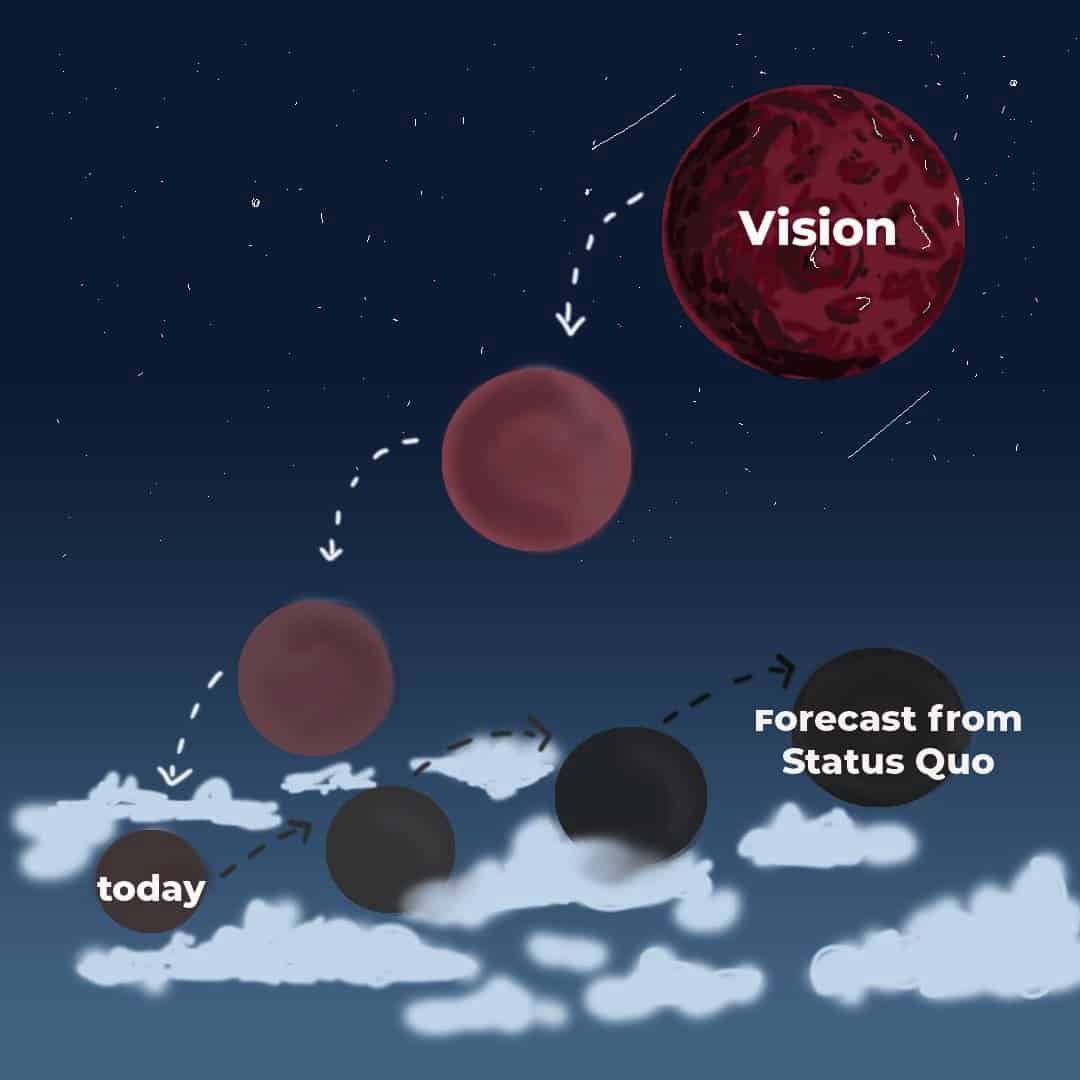
For many of us, planning for the future is forecasting. Forecasting is a review of the current and past and extrapolating a future. In our personal lives too, we let our current skills drive our future vision. Forecasting takes all the current biases into account. Backcasting shifts the script. Instead of forecasting the future, backcasting helps in creating an imagined future.
The best way to predict the future is to invent it
Alan Kay
In backcasting, vision drives resources and not the other way around.
Forecasting Vs Backcasting
In forecasting, we look at the past and also the resources we have. While we forecast we ask "What can we do with what we have?". This extends the status quo into the future. This artificially restricts the vision of what is possible.
In backcasting, we start with our bold ambition. Then convert that into actionable steps. For eg we visualize our ideal product and ask what it takes to build it. We visualize our imagined future of anything and work backward. One way to get an imagined future is by asking this question by filling the blank with the area you are envisioning.
What is the future of .........................?
For eg.
What is the future of fashion consumption?
What is the future of fashion sustainability?
What is the future of fashion forecasting?
What is the future of planning?
What is the future of mobility? etc.
Only when we start sketching a blueprint for the future now, will we be forced to separate fact from fiction.
Backcasting In Action
NASA started with the vision of landing humans on the moon and worked backward to determine the necessary steps to get there.
Amazon takes a similar backcasting in its product releases. Amazonians write internal press releases before starting product initiatives. The press releases function as a thought experiment. The press releases describe customer problems, how current solutions fail and how the new product will blow away existing solutions. The press release includes a six-page list of hypothetical frequently asked questions from customers. This exercise forces the Amazonians to put themselves in a non-expert chair and view the solution. In other words, this process inexpensively evaluates new ideas without even investing in them. Iterating on "press release" is a lot effective than iterating in the real world.
The Hardest First
Imagine you are given an audacious project to get a monkey to stand on a pedestal and recite passages from Shakespeare. How ill you begin?
It is easier to get a monkey on a pedestal. You may start by building a pedestal. The difficult part is making the monkey talk. You need to assess if the project has an Achilles Heel, if the monkey can't be trained to talk, leave alone recite. The more time you spend on building a pedestal, the harder it becomes to move away from the Mars shot.
This is the sunk cost fallacy. We value the time we invest in any project and stick to it. In order to avoid this fallacy, work on the most difficult task ahead in the project. As you do this, create go/no-no metric/s for you to assess the feasibility of the project.
What is easy often is not important, and what is important often is not easy
Our Journey
Having spent a good time in the trenches of the fashion business, in 2015, we asked few questions on first principles, a kind of backcasting.
Why is there so much of a gap between supply and demand in fashion resulting in over USD 750 billion of wastage every year in the production of unwanted goods?
Why are current practices of fashion forecasting and demand planning not helping the cause?
What is the future of fashion research, demand planning, assortment planning?
This resulted in "New Thinking".
It was not easy to travel a path never traveled before.
We put consumers at the center of everything. We invented Demand Science®.
We also created a unique demand prediction model specially designed for art forms like fashion which estimates the True Demand of new unseen products with industry-leading accuracies. You can read more about our innovations here, here, and here.
It is always day 1 and the journey continues.
In Conclusion,
That is our Mars-shot for you.
Be more unreasonable. Many breakthroughs are reasonable only in the hindsight. If we restrict ourselves to what is possible with what we have, we will never reach escape velocity and create a new future.
In essence, all Mars-shots are impossible.
Until you decide to start.
Reference: Rocket Scientist, Cover image courtesy: Prada.Art

.jpg)
.jpg)