Your Buying Committee Is Destroying Your Product Selection Hit Rate
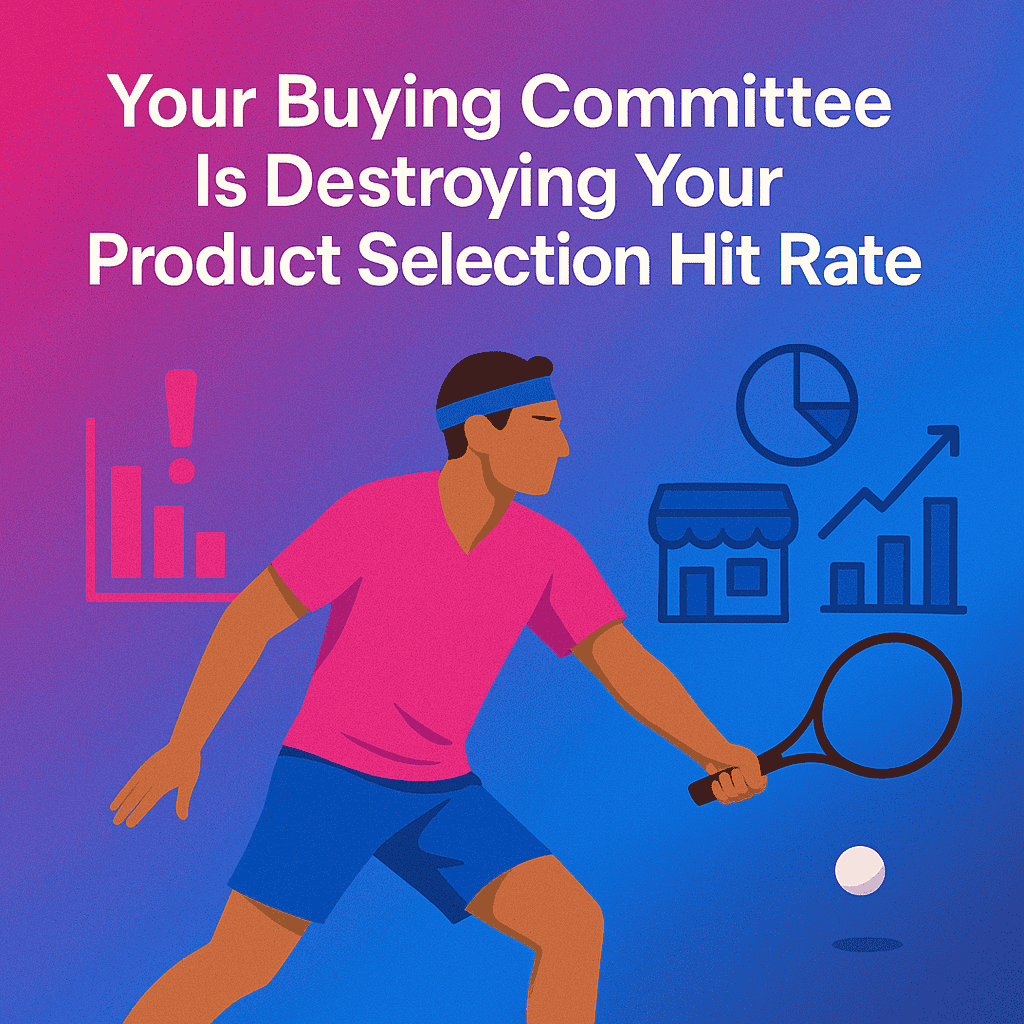
The same conversation happens every week in conference rooms across retail. A buying committee gathers around a table. Samples spread out. Mood boards on screens. Someone mentions what competitors are doing. Someone else references last season’s winners. The design team defends their vision. Merchants push back on cost. Everyone has an opinion. A few voices dominate. Consensus forms around what feels safe, what looks familiar, what the loudest person in the room believes will work. The committee votes. The product gets greenlit. Six months later it is on a clearance rack at 60 percent off.
This is not a failure of effort or talent. It is a structural failure. Your buying committee is an unforced error factory. And it is destroying your product selection hit rate in ways that cost you millions every season.
THE UNFORCED ERROR PROBLEM
In professional tennis, roughly 75 percent of points end in an error, not a winner. At Grand Slam events, between 61 and 83 percent of winning points happen because the opponent made a mistake, not because someone hit an unreturnable shot. The French Open, played on slower clay courts, sees the highest error rate. The player who wins is not the one who hits the most spectacular shots. It is the one who makes fewer unforced errors. The difference between Novak Djokovic and a top 50 player is not supernatural talent. It is decision discipline at critical moments. Djokovic does not go for the low-percentage shot when a high-percentage play is available. He does not beat himself.
Retail operates the opposite way. The industry celebrates the occasional winner, the breakout product that exceeds expectations, while ignoring that 70 to 95 percent of new products fail within their first year. Consumer packaged goods see an 85 percent failure rate. Fashion and apparel sit at 40 to 50 percent 9as measured by full price sell through). Even peer-reviewed research that reports more conservative figures still shows failure rates of 40 percent or higher. Seventy-five percent of retail products fail to earn even $7.5 million in their first year. These are not forced errors, situations where the market shifted unexpectedly or a competitor made an unpredictable move. These are unforced errors. Products that should never have been made in the first place. Decisions made on gut instinct, committee consensus, or last season’s data instead of actual demand signals.
The cost is staggering. Over 30 percent of retail inventory ends up marked down annually. Average markdown rates run 7 to 9 percent of total sales. Inventory that does not turn sits in warehouses, tying up capital and accruing holding costs until it gets cleared at 30 to 70 percent discounts. Every clearance rack, every end-of-season blowout, every margin squeeze traces back to one upstream moment. The moment a buying committee said yes to the wrong product before demand was validated.
WHY YOUR PRODUCT SELECTION HIT RATE HASN’T MOVED IN 30 YEARS
The retail product success rate has been stuck in the same range for three decades. Not because retailers lack data. Not because they lack talented merchants. Because the merchandise selection process itself is fundamentally broken. Buying committees operate on a decision framework designed for a world that no longer exists. A world where trend cycles moved slowly. Where consumer preferences were predictable. Where six-month lead times gave you room to correct mistakes. That world is gone. The decision process remains.
The typical assortment planning decisions process looks like this. Historical sales data from last season gets analyzed. Trend reports get commissioned. Competitors get monitored. Design teams create samples. The buying committee convenes. Opinions get shared. Consensus gets negotiated. Products get selected. Orders get placed. Six months later the product hits stores. By then, the trend has shifted. The color palette consumers wanted three months ago is not the one they want now. The silhouette that felt fresh in the showroom looks dated on the floor. The committee made the best decision they could with the information they had at the time. The decision was still wrong.
This is not incompetence. This is structure. The buying committee model assumes that aggregating diverse opinions produces better outcomes than individual decision making. Research shows the opposite. Group decision making in uncertain environments does not improve accuracy. It amplifies bias. Committees converge on consensus, not truth. The loudest voice wins. The safest option gets selected. Risk aversion becomes the default. Nobody gets fired for picking what everyone agreed on, even when everyone agreed on the wrong thing.
A major sportswear brand analyzed five years of product launches. Products selected by committee consensus had a 34 percent success rate. Products selected by individual merchants using demand signal data had a 61 percent success rate. The difference was not the quality of the people in the room. It was the quality of the decision framework. Committees optimized for agreement. Individual merchants using data optimized for demand.
THE CONSENSUS BIAS TRAP
Buying committee effectiveness suffers from a problem behavioral economists call groupthink. When a committee forms, individual members start optimizing for group harmony instead of decision accuracy. Dissenting opinions get softened. Contrary data gets dismissed. The desire to reach consensus overrides the need to be right. This is not a personality flaw. This is how human decision making works in group settings.
A leading fast fashion retailer tracked buying committee discussions for an entire season. In 73 percent of meetings, the first strong opinion voiced became the final decision. Subsequent discussion did not challenge the initial position. It reinforced it. Committee members looked for evidence that supported the early consensus and ignored evidence that contradicted it. Confirmation bias at scale. The committee was not evaluating options. It was justifying a decision it had already made in the first five minutes.
The problem gets worse when committees rely on historical data. Last season’s winners become this season’s template. If animal prints sold well six months ago, the committee greenlights more animal prints. If oversized silhouettes moved inventory, the committee doubles down on oversized. This works until it does not. Trends have shelf lives. Consumer preferences shift. What worked last season is precisely what will not work next season because the market has already moved on. But the committee does not see that. The committee sees last quarter’s sales report and assumes the pattern will repeat.
A global department store chain ran an experiment. Half of their buying committees received only historical sales data. The other half received historical data plus real time consumer search and engagement signals. The committees with real time data selected products with a 47 percent higher sell through rate. They were not smarter. They were not more experienced. They had better inputs. The decision process was identical. The information environment was different. That difference translated directly into inventory decision quality.
DEMAND FORECASTING ACCURACY VERSUS COMMITTEE INTUITION
Retailers treat demand forecasting accuracy as a technical problem. Better algorithms. More data points. Sophisticated models. But the most advanced forecast in the world is useless if the buying committee ignores it. And they do. Constantly. A forecast that contradicts committee intuition gets dismissed as flawed. A forecast that confirms what the committee already believes gets accepted without scrutiny. The committee is not using the forecast to make better decisions. The committee is using the forecast to justify decisions they have already made.
A major grocery chain implemented a machine learning demand forecasting system. The system analyzed purchase patterns, seasonal trends, regional preferences, and external factors like weather and local events. The forecasts were 68 percent more accurate than the previous manual process. Eighteen months later, the system was barely used. Buyers complained it did not align with their category knowledge. What they meant was it did not align with their assumptions. The system recommended reducing orders on products the buyers believed would perform well. The buyers overrode the system. The products underperformed. The buyers blamed the system. The cycle repeated.
This is not a technology problem. This is a trust problem. Committees trust their intuition more than they trust data because intuition feels like expertise. A merchant with 15 years of experience believes they know their category. They do know their category as it existed for the last 15 years. They do not know their category as it exists right now because right now is always different from before. Consumer behavior is not static. Preferences evolve. Trends accelerate. What worked last year is not a reliable guide to what will work next month. But intuition does not update in real time. Data does.
The retailers who have improved their product selection hit rate did not do it by hiring better merchants or running more committee meetings. They did it by changing the decision framework. They moved from consensus-driven selection to signal-driven selection. They stopped asking what the committee thinks will work and started measuring what consumers are actually responding to before committing capital. They treated product selection like Djokovic treats shot selection. Not as an opportunity to showcase intuition, but as a discipline of making the highest-probability decision available.
THE STRUCTURAL COST OF GETTING IT WRONG UPSTREAM
Every product that fails starts as a decision someone made in a conference room. That decision triggers a cascade. Design resources get allocated. Manufacturing capacity gets reserved. Purchase orders get placed. Inventory gets produced. Warehouse space gets consumed. Capital gets tied up. Marketing campaigns get planned. Store space gets allocated. Sales teams get briefed. All of this happens before a single consumer sees the product. By the time the product hits the market, the cost of being wrong is already locked in.
A leading home goods retailer calculated the fully loaded cost of a failed product introduction. Design and development, $47,000 per SKU. Tooling and first production run, $183,000. Inventory holding costs over six months, $62,000. Markdown costs to clear unsold inventory, $118,000. Opportunity cost of the shelf space and capital that could have gone to a winning product, incalculable. Total cost per failed SKU, over $410,000. They launched an average of 340 new SKUs per year. All of it traceable to upstream assortment planning decisions made by buying committees six to nine months before launch.
The math is worse in fashion. A major apparel brand analyzed three years of product launches. The average failed product generated $340,000 in costs before markdowns and $890,000 after markdowns and write-offs. Successful products generated an average gross margin of $1.2 million. The brand launched 520 products per year. At a 72 percent failure rate, they had 374 failures and 146 successes. Total value destruction from failures, $332 million. Total value creation from successes, $175 million. Net result, $157 million in losses despite having winners in the assortment. The winners could not compensate for the volume of losers. The brand was not failing because they could not pick winners. They were failing because they could not stop picking losers.
This is the unforced error problem at scale. Retailers do not need to hit more winners. They need to stop greenlighting obvious losers. A tennis player who reduces unforced errors from 40 per match to 25 per match does not need to hit more aces. They just need to not beat themselves. A retailer who reduces product failures from 70 percent to 40 percent does not need blockbuster hits. They just need to stop making products nobody wants.
THE ALTERNATIVE TO COMMITTEE CONSENSUS
The solution is not to eliminate buying committees. The solution is to change what buying committees do. Stop using committees to make selection decisions. Use committees to evaluate demand signals. The decision is not what do we think will work. The decision is what is the data telling us consumers want right now.
A global beauty retailer rebuilt their product selection process around this principle. Instead of gathering the committee to debate product concepts, they gathered the committee to review consumer response data. Search volume for specific ingredients. Engagement rates on social content featuring certain product types. Sell-through velocity on test launches in limited markets. Reorder rates on existing products with similar attributes. The committee’s job was not to predict demand. The committee’s job was to interpret signals of existing demand and decide which signals were strong enough to justify a full launch.
The results were immediate. First-year product success rates went from 31 percent to 64 percent. Markdown rates dropped from 34 percent to 18 percent. Inventory turns increased by 43 percent. Gross margin improved by 9 percentage points. The committee was not smarter. The committee was not more experienced. The committee was making decisions based on evidence of demand instead of assumptions about demand. They were still wrong sometimes. They were wrong half as often.
This is what decision discipline looks like in retail. Not perfect prediction. Fewer unforced errors. Not chasing every trend. Validating demand before committing capital. Not trusting intuition. Trusting signals. The buying committee becomes a signal evaluation team. The merchandise selection process becomes a demand validation process. The question is not what should we make. The question is what is already working in the market that we can scale.
A major electronics retailer applied this framework to their accessory category. Historically, accessory selection was driven by buyer intuition and vendor pitches. Success rate was 29 percent. They shifted to a test-and-read model. Small batch launches in select markets. Real-time monitoring of sell-through, return rates, and customer reviews. Committee meetings focused on interpreting performance data, not debating product merit. Products that hit thresholds got scaled. Products that missed thresholds got cut. Success rate went to 58 percent in the first year and 67 percent in the second year. Same buyers. Same vendors. Different decision process.
WHAT DECISION DISCIPLINE ACTUALLY REQUIRES
Decision discipline sounds simple. It is not easy. It requires retailers to admit that intuition is not expertise. It requires buying committees to accept that their job is not to be right, but to avoid being wrong. It requires organizations to value evidence over opinion. It requires merchants to trust data even when it contradicts their experience. It requires executives to stop celebrating the occasional blockbuster and start measuring the baseline hit rate. Most retailers are not willing to make these changes. That is why most retailers still have the same product selection hit rate they had 30 years ago.
The retailers who do make these changes do not do it because they read a blog post. They do it because the cost of not changing finally exceeds the discomfort of changing. They do it because another quarter of markdowns just crushed their margin. They do it because a competitor with a higher hit rate just took market share they are not getting back. They do it because their board is asking why inventory turns are declining while the industry average is improving. They do it because the current process is visibly, measurably, undeniably broken and everyone in the organization knows it.
If you are reading this and thinking your buying committee is fine, you are either the exception or you are not measuring the right things. Track your product-level success rate. Not category performance. Not total sales. Individual SKU success rate. What percentage of the products you launched this year met or exceeded their sales plan without requiring markdowns deeper than 20 percent. If that number is above 60 percent, you are doing better than most. If it is below 40 percent, you have an unforced error problem. If you do not know the number, that is the problem. Even your rates are better, there is a huge scope yto further improve as there is so much white space left for improvement.
CONCLUSION
Your product selection hit rate is not a mystery. It is a direct output of your decision process. Buying committees that operate on consensus and intuition produce unforced errors at scale. Committees that operate on demand signals and decision discipline produce measurably better outcomes. The difference is not talent. The difference is structure. You can keep running your buying process the way you have always run it and keep getting the hit rate you have always gotten. Or you can treat product selection like a discipline, measure the quality of your decisions, and stop greenlighting products that should never have been made. The choice is structural. The cost of inaction is not.
If you want to see how decision discipline translates into measurable hit rate improvements for your business, our team offers a free consultation tailored to your retail context. You can reach us at https://www.stylumia.ai/get-a-demo/. We will demonstrate how our suite of Orbix AI agents are helping brands and retailers globally.
KEY TAKEAWAYS
Your buying committee is not failing because of bad people. It is failing because group consensus optimizes for agreement, not accuracy, and that structural flaw costs you millions in markdowns every year.
Retail product selection hit rate has not improved in 30 years because the decision process has not changed. Committees still rely on intuition and historical data in a market that moves faster than either can track.
Reducing unforced errors matters more than hitting occasional winners. A retailer that cuts failure rate from 50 percent to 20 percent does not need blockbusters. They just need to stop making products nobody wants.
Demand forecasting accuracy is useless if buying committees ignore forecasts that contradict their assumptions. The problem is not the data. The problem is the committee’s relationship to the data.
Decision discipline requires changing what buying committees do. Stop debating what might work. Start evaluating signals of what is already working and decide which signals justify scaling.
The fully loaded cost of a failed product includes design, production, inventory holding, markdowns, and opportunity cost. For most retailers, that number exceeds $400,000 per SKU. Multiply that by your failure rate and you see the real cost of your current process.
Retailers who improved their hit rate did not hire better merchants. They changed the decision framework from consensus-driven selection to signal-driven validation, and the results showed up in margin within two quarters.
FREQUENTLY ASKED QUESTIONS
What is a good product selection hit rate for retail?
A product selection hit rate above 60 percent puts you ahead of most retailers. Anything below 40 percent means your buying process is generating more losers than winners, and the cost of those failures is likely erasing the margin from your successes. If you do not track SKU level success rate, start now. You cannot fix what you do not measure.
Why do buying committees make worse decisions than individual merchants?
Buying committees optimize for consensus, not accuracy. Group dynamics create pressure to agree, which amplifies bias and suppresses dissenting opinions. Individual merchants using demand signal data make decisions based on evidence, not negotiation. Research shows committee-selected products succeed 34 percent of the time while signal-driven selections succeed 61 percent of the time.
How do I improve demand forecasting accuracy in my organization?
Demand forecasting accuracy improves when you use real-time consumer signals, not just historical sales data. Search volume, engagement rates, test market performance, and reorder velocity tell you what consumers want now. Historical data tells you what they wanted six months ago. Combine both, but weight recent signals higher. Then make sure your buying committee actually uses the forecast instead of overriding it with intuition.
What is the biggest mistake retailers make in assortment planning decisions?
The biggest mistake is greenlighting products based on what worked last season. Trends have shelf lives. Consumer preferences shift. What sold well six months ago is often exactly what will not sell next season because the market moved on. Retailers who rely on historical performance as their primary input are always one cycle behind.
How much does a failed product actually cost?
A failed product costs far more than the markdown. Add design and development, tooling, production, inventory holding, warehouse space, opportunity cost of capital, and markdown losses. For most categories, the fully loaded cost per failed SKU exceeds $400,000. In fashion, it can reach $890,000. Multiply that by your annual failure rate and you see why hit rate matters more than total revenue.
Can buying committees still add value if they are not making selection decisions?
Buying committees add value when they evaluate demand signals instead of debating product concepts. Use the committee to interpret consumer response data, assess test market performance, and decide which signals justify scaling. The committee’s expertise is valuable for interpretation, not prediction. Change the input from opinion to evidence and the output quality changes immediately.
What does decision discipline look like in practice for retail?
Decision discipline means validating demand before committing capital. Launch small batches in test markets. Monitor sell-through, returns, and engagement in real time. Scale what works. Cut what does not. Use buying committees to evaluate performance data, not to predict performance. Measure your hit rate at the SKU level every quarter. Treat product selection like shot selection in tennis. Make the highest-probability decision available, not the most exciting one.