Stop Optimizing Retail : Rebuild It From Fundamental Truths
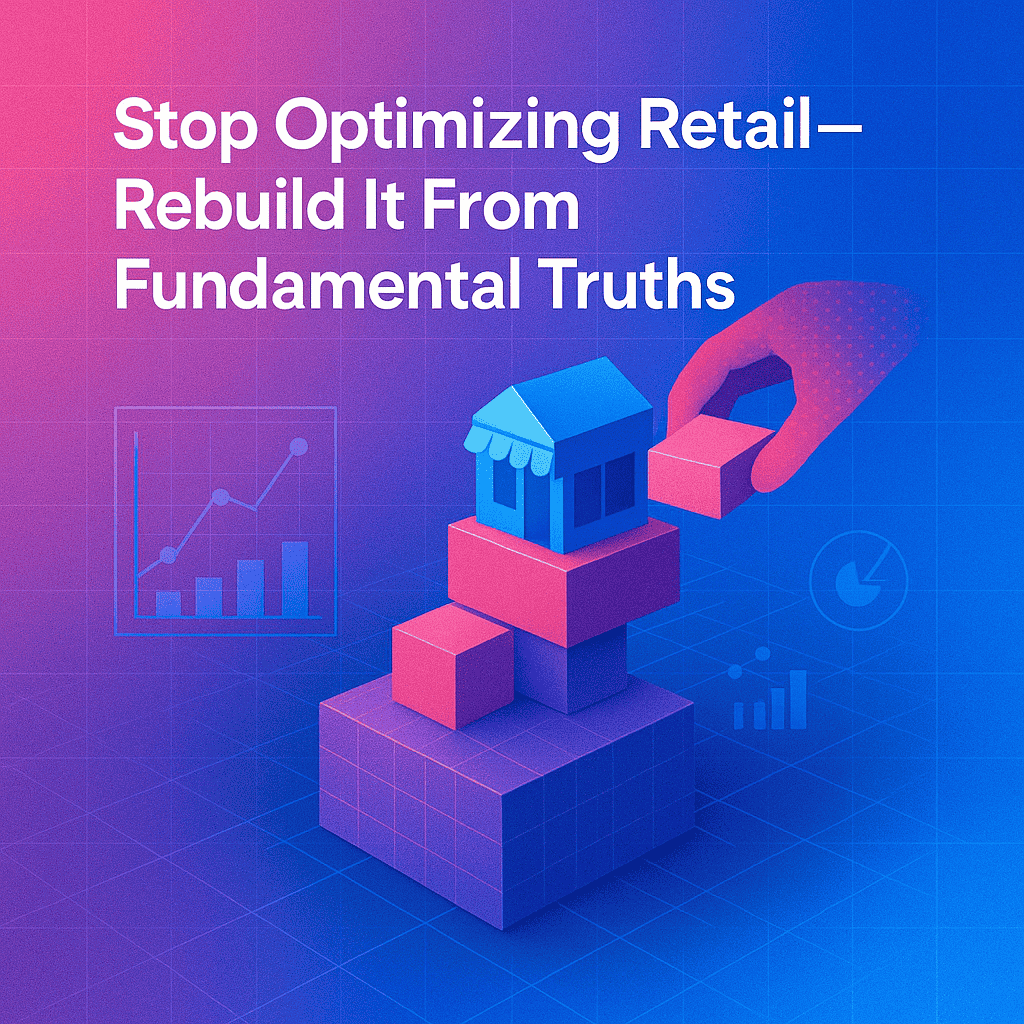
Your entire retail strategy is built on a foundation of inherited lies. This is a provocative conversation for discovering a new path.
Not deliberate deceptions, but unexamined assumptions that calcified into doctrine over decades. You assume stores must hold inventory because that is how stores have always worked. You assume customers must visit locations because retail has always required foot traffic. You assume fulfillment happens after purchase because the transaction has always preceded the shipment. These are not truths. They are artifacts of technological limitations that no longer exist, yet they still govern how you allocate capital, design processes, and define success. A first principles retail strategy demands you question every inherited assumption before optimizing a single process.
The result is an industry optimizing its way into irrelevance. While traditional retailers have spent the past two decades perfecting inventory turns and negotiating lease rates, companies that questioned the very premise of retail have created value at scales that make optimization look like rearranging deck chairs. Amazon’s market capitalization stands at $2.56 trillion. Amazon is worth roughly 1.4x the combined value of next four retailers.The math is unforgiving. A single company that rebuilt retail from fundamental truths is worth more than twice the combined value of the four largest traditional retailers.
This is not a story about better execution. It is a story about different premises. Retail business model innovation does not emerge from incremental improvements to existing frameworks. It emerges from questioning retail assumptions that everyone else accepts as immutable law.
THE ROCKET THAT LANDED BECAUSE SOMEONE ASKED WHY NOT
In 2002, Elon Musk wanted to buy a rocket to send mice to Mars. Russian ICBMs retrofitted for satellite launches cost $65 million. He asked a different question. Not where can I find a cheaper rocket, but what is a rocket made of. Aluminum alloys, copper wiring, carbon fiber composites. Commodity materials trading at roughly two percent of the ticket price for orbital launch services. The other 98 percent was labor, overhead, and margin accumulated across a supply chain that had never been challenged.
SpaceX was born from that question. The company built rockets in-house, eliminating supplier markups. It designed for reusability when the entire aerospace industry insisted rockets must be expendable. The conventional wisdom had physics on its side. Rockets endure extreme thermal and mechanical stress. Refurbishing them costs more than building new ones. Except it does not, if you design for reuse from the beginning rather than bolting reusability onto an expendable architecture.
Falcon 9 now launches payloads to low Earth orbit for approximately $2,720 per kilogram. The Space Shuttle cost $54,500 per kilogram. That is not a 20 percent improvement from better project management. It is a 95 percent cost reduction from questioning whether rockets must be thrown away after a single use. SpaceX’s internal cost per launch has fallen below $30 million for missions that competitors cannot execute for less than $150 million.
This is first principles thinking. Strip away analogies, conventions, and industry best practices. Identify the fundamental physical and economic truths. Rebuild from there. The approach works identically in aerospace and apparel, in rocketry and retail. The question is whether you have the intellectual courage to use it.
YOUR INVENTORY OPTIMIZATION LIMITATIONS ARE SELF-IMPOSED
A major home goods retailer operates 1,200 stores averaging 32,000 square feet. Each location stocks approximately 12,000 SKUs across furniture, decor, and seasonal categories. The company employs sophisticated demand forecasting algorithms that analyze point-of-sale data, regional demographics, and weather patterns to optimize inventory allocation. Turns have improved 18 percent over five years. Stockouts have decreased 12 percent. Wall Street applauds the operational discipline.
The entire exercise is built on a false premise. The assumption that stores must hold inventory.
Why must a furniture showroom stock mattresses in a back room? The customer cannot take a queen-size mattress home in a sedan. Delivery happens days later regardless. The inventory holding cost, the warehouse space, the capital tied up in safety stock, all of it exists to serve a model where the store is a fulfillment center pretending to be a showroom. A first principles retail strategy asks what function the physical space actually serves. If the answer is product discovery and purchase decision support, then inventory belongs in centralized fulfillment centers with lower occupancy costs and consolidated safety stock, not distributed across hundreds of locations with redundant overhead.
A leading electronics retailer faces the same false constraint. High-value items like laptops and cameras require security fixtures, theft prevention systems, and insurance premiums that scale with inventory value per square foot. The retailer optimizes shrinkage rates and turns inventory faster to reduce exposure. The fundamental question goes unasked. Why must high-value electronics sit in suburban strip malls? Customers research specifications online before visiting. They want to see build quality, test ergonomics, and compare display performance. Those needs require one demonstration unit per SKU, not 40 units in a stock room.
Retail legacy constraints are not operational problems to be solved. They are strategic choices to be unmade. Questioning retail assumptions about where inventory lives, who owns it before purchase, and when it moves unlocks capital efficiency that optimization cannot touch. A Fortune 500 fashion retailer that shifted from store inventory to centralized fulfillment with showroom locations reduced working capital requirements by 34 percent while increasing SKU variety by 60 percent. The stores got smaller, the selection got larger, and the balance sheet got stronger. That is not better inventory management. That is a different inventory philosophy.
AMAZON RETAIL DISRUPTION STARTED WITH A QUESTION ABOUT BOOKSTORES
In 1994, Jeff Bezos identified books as the optimal product category for online retail. Not because people loved buying books remotely, but because the economics of physical bookstores were structurally broken. A typical bookstore stocked 40,000 titles. The number of books in print exceeded 3 million. Customers who wanted anything outside the narrow selection had to special order and wait weeks. The constraint was not consumer preference. It was the physics of retail space and the economics of inventory holding costs.
Amazon did not build a better bookstore. It built a different model that eliminated the constraint. No physical locations meant no rent per square foot. No inventory display requirements meant stocking only what sold. Centralized warehouses meant consolidated safety stock instead of distributed redundancy. The customer experience improved because the business model removed artificial limitations that physical retail had always accepted as unchangeable.
The approach scaled beyond books because the insight was never about books. It was about retail strategic transformation through fundamental retail rethinking. What constraints does physical retail impose that customers do not actually value? Bezos identified several. Limited selection. Geographic inconvenience. Inventory risk forcing retailers to stock only proven sellers. Each constraint represented an opportunity to rebuild the model around what customers actually wanted rather than what retail economics had always required.
The marketplace model extended the logic. Amazon did not need to own inventory to facilitate transactions. Third-party sellers could list products, manage stock, and handle fulfillment while Amazon provided discovery, transaction processing, and logistics infrastructure. Traditional retailers saw this as a loss of control. Amazon saw it as removing the capital intensity that made retail a low-margin business. A major beauty retailer generates 6 percent net margins managing inventory, real estate, and fulfillment. A marketplace operator generates 25 percent margins providing infrastructure. Same customer, same transaction, completely different business model built on completely different premises.
Subscription services attacked another unexamined assumption. Retail has always been transactional. Customers buy products when they need them. Except many products are consumed predictably. Diapers, vitamins, pet food, razor blades. The replenishment cycle is forecastable, but traditional retail forces customers to remember, travel, and repurchase. A subscription model that automates replenishment reduces customer effort while giving the retailer demand visibility that enables better inventory planning and supplier negotiations. A leading grocery chain that introduced subscriptions for household staples increased customer lifetime value by 40 percent while reducing demand forecast error by 28 percent.
These are not incremental improvements. They are business model innovations that emerge from questioning whether retail must work the way it has always worked.
FIRST PRINCIPLES RETAIL STRATEGY REQUIRES INTELLECTUAL HONESTY ABOUT WHAT YOU ACTUALLY SELL
A premium fashion brand operates 300 boutiques in high-traffic urban locations. The stores are beautiful. Marble floors, custom lighting, attentive staff. The brand insists physical retail is essential to the luxury experience. Customers need to touch fabrics, see craftsmanship, and receive personalized service. The stores are not distribution points. They are brand temples.
Except the data tells a different story. Seventy percent of purchases happen after multiple store visits. Customers browse in person, research online, compare prices, and return to buy. The transaction is the least valuable part of the store visit. The valuable interaction is the product education and brand immersion that happens before purchase intent forms. A first principles retail strategy separates these functions. If the store’s purpose is brand experience and product discovery, then optimize for those outcomes. Remove checkout counters. Eliminate inventory storage. Train staff as product educators, not sales closers. Let customers complete purchases on mobile devices for home delivery.
A major home improvement retailer faces a similar misalignment. Customers visit stores to solve problems, not buy products. They need to understand whether a particular faucet fits their sink configuration, whether a paint color matches their furniture, whether they have the skills to install flooring themselves. The store’s value is problem-solving expertise, but the business model is product sales. The retailer optimizes for transaction efficiency when it should optimize for solution clarity. A first principles approach would monetize the expertise directly through consultation fees, installation services, and project management, treating product sales as a downstream consequence rather than the primary revenue model.
Retail strategic transformation starts with brutal honesty about what customers actually value in your model. If they value convenience, then real estate is a liability, not an asset. If they value expertise, then product margins are the wrong revenue source. If they value selection, then owned inventory is a constraint, not a capability. The business model should monetize what customers value, not what retail has always monetized.
FUNDAMENTAL RETAIL RETHINKING MEANS ADMITTING YOUR COMPETITORS ARE NOT WHO YOU THINK
A leading electronics retailer defines its competitive set as other electronics retailers. It benchmarks pricing against them, matches their promotional calendars, and celebrates market share gains within the category. The entire framework is obsolete. The competition is not other stores selling televisions. It is any alternative use of the customer’s time and capital.
When a customer decides not to upgrade their television, the victory does not go to a competing electronics retailer. It goes to a streaming service subscription, a restaurant meal, a vacation, or a brokerage account. The customer allocated their discretionary spending elsewhere. Traditional retail analytics cannot see this competition because it only tracks transactions that happen, not decisions that prevent transactions. A first principles retail strategy recognizes that you are not competing for category share. You are competing for relevance in a customer’s life.
This realization changes everything. If your competition is irrelevance, then product assortment is not your primary weapon. Friction reduction is. A major grocery chain that introduced one-hour delivery did not win because its produce was superior. It won because it eliminated the decision fatigue and time cost that made cooking at home less appealing than restaurant delivery. The competition was not other grocery stores. It was DoorDash.
A premium beauty retailer that introduced virtual try-on technology did not win because its cosmetics were better formulated. It won because it reduced the uncertainty and effort that made repurchasing familiar products safer than experimenting with new ones. The competition was not other beauty retailers. It was the status quo.
Retail business model innovation emerges when you correctly identify what you are actually fighting. If you are fighting friction, then real estate is a source of friction, not a competitive advantage. If you are fighting irrelevance, then product margins are less important than engagement frequency. If you are fighting inertia, then subscription models that automate decisions are more valuable than promotional pricing that requires active choice.
Your competitive strategy is built on a misdiagnosis of who you are competing against. Fix the diagnosis, and the strategy fixes itself.
THE CAPITAL ALLOCATION TEST THAT EXPOSES STRATEGIC DELUSION
A Fortune 500 retailer allocates capital across five priorities. Store renovations, inventory expansion, supply chain automation, digital marketing, and technology infrastructure. The allocation reflects a strategy of incremental improvement across existing capabilities. Better stores, more products, faster fulfillment, broader reach, smoother operations. Every investment makes sense in isolation. Together, they represent a commitment to optimizing a model that may not deserve optimization.
A first principles retail strategy applies a different test. For each capital allocation, ask what assumption it reinforces. Store renovations assume physical retail remains central to the customer relationship. Inventory expansion assumes owned stock is necessary for sales. Supply chain automation assumes the current fulfillment model is correct but inefficient. Digital marketing assumes customer acquisition is the constraint rather than retention. Technology infrastructure assumes the existing business processes are worth digitizing.
What if those assumptions are wrong? What if physical retail is a legacy cost structure, not a customer preference? What if inventory ownership is a capital trap, not a competitive advantage? What if the fulfillment model is fundamentally broken, not just slow? What if retention matters more than acquisition? What if the business processes themselves are the problem?
A leading fast fashion brand faced this test. It could invest in faster inventory turns and better demand forecasting to reduce markdowns. Or it could question why it owned inventory at all. The brand shifted to a marketplace model for 40 percent of its assortment, allowing third-party designers to list products with the brand providing discovery, transaction processing, and logistics coordination. Inventory risk transferred to suppliers. Capital intensity dropped. Margin structure improved. The decision was not better inventory management. It was a rejection of inventory ownership as a necessary component of the business model.
Capital allocation reveals strategic commitment. If your investments reinforce existing assumptions, you are optimizing. If they test and replace assumptions, you are rebuilding. The difference determines whether you are competing in the future of retail or perfecting the past.
CONCLUSION
Your retail strategy is not failing because you execute poorly. It is failing because you are executing the wrong strategy with impressive discipline. Every optimization you celebrate, every efficiency you unlock, every basis point of margin you protect, all of it makes you better at a model that the market is systematically devaluing. A first principles retail strategy does not ask how to improve what you do. It asks whether what you do should exist at all.
The retailers winning the next decade will not be the ones with the best inventory turns. They will be the ones who questioned whether stores should hold inventory. They will not be the ones with the most locations. They will be the ones who questioned whether retail requires locations. They will not be the ones with the fastest supply chains. They will be the ones who questioned whether fulfillment must follow purchase. Retail business model innovation belongs to those with the intellectual courage to discard inherited assumptions and rebuild from fundamental truths.
Amazon is worth more than your four largest competitors combined not because it executes better. It is worth more because it started with different premises. You can close that gap with better operations. You can only close it by questioning retail assumptions that everyone else treats as immutable. The math is unforgiving. The choice is binary. Optimize the past or rebuild the future. There is no third option.
KEY TAKEAWAYS
A first principles retail strategy questions inherited assumptions about inventory, fulfillment, and business models rather than optimizing existing processes that may be fundamentally flawed.
Retail business model innovation emerges from separating what customers actually value from what retail has traditionally monetized, enabling new revenue models and capital structures.
Inventory optimization limitations are often self-imposed constraints based on assumptions that stores must hold stock rather than fundamental customer requirements.
Amazon retail disruption succeeded by eliminating structural constraints of physical retail rather than building better bookstores, a lesson applicable across all retail categories.
Questioning retail assumptions about where inventory lives, who owns it, and when it moves unlocks capital efficiency that incremental optimization cannot achieve.
Retail strategic transformation requires correctly identifying your actual competition, which is often customer inertia and irrelevance rather than other retailers in your category.
Capital allocation decisions reveal whether you are optimizing an obsolete model or funding fundamental retail rethinking that challenges core business premises.
FREQUENTLY ASKED QUESTIONS
Q1: What is a first principles retail strategy and how does it differ from traditional retail optimization?
A1: A first principles retail strategy strips away inherited assumptions about how retail must work and rebuilds business models from fundamental truths about customer needs and economic constraints. Traditional optimization improves existing processes like inventory turns and supply chain speed. First principles thinking questions whether those processes should exist at all, asking why stores must hold inventory, why fulfillment must follow purchase, or why retailers must own stock to facilitate sales. The difference is between making an obsolete model more efficient and replacing it with a model built on current technological and economic realities.
Q2: How do retail legacy constraints limit strategic innovation even at well-managed companies?
A2: Retail legacy constraints create invisible boundaries around strategic thinking by treating historical limitations as permanent requirements. Physical store networks built when geography mattered become fixed costs that bias decisions toward store-centric models. Inventory ownership practices developed when suppliers had power become assumed necessities even when marketplace models offer better capital efficiency. Fulfillment processes designed for in-store pickup become optimization targets rather than candidates for elimination. Well-managed companies execute these inherited models with discipline, which makes them better at approaches the market is devaluing rather than forcing the fundamental retail rethinking required for transformation.
Q3: What are the most common retail assumptions that should be questioned in a first principles approach?
A3: The most limiting assumptions include the belief that stores must hold inventory rather than serve as showrooms with centralized fulfillment, that retailers must own products before selling them rather than operating marketplaces, that fulfillment must follow purchase rather than being automated through subscriptions, that physical locations create competitive advantages rather than fixed cost burdens, that category competitors matter more than competition from customer inertia, and that retail monetizes products rather than expertise, convenience, or curation. Questioning retail assumptions in these areas reveals business model innovations that optimization cannot access.
Q4: How does Amazon retail disruption demonstrate the value of rebuilding rather than optimizing?
A4: Amazon retail disruption succeeded by identifying structural constraints in physical retail and building models that eliminated them rather than working within them. Bookstores could stock 40,000 titles due to space economics. Amazon eliminated space constraints through centralized warehouses and offered millions of titles. Physical retail required inventory ownership and associated capital costs. Amazon built marketplaces where third parties owned inventory while Amazon provided infrastructure. Traditional retail was transactional. Amazon introduced subscriptions that automated repurchase. Each innovation rejected an assumption the industry treated as unchangeable, creating value that optimization of traditional models could never capture.
Q5: What inventory optimization limitations prevent retailers from achieving Amazon-level capital efficiency?
A5: Inventory optimization limitations stem from accepting that stores must hold stock rather than questioning the premise. Retailers optimize turns, reduce safety stock, and improve forecasting, but these efforts work within a model where inventory is distributed across hundreds of locations with redundant overhead and capital tied up in each. A first principles approach recognizes that if stores serve discovery and decision support, inventory belongs in centralized fulfillment centers with consolidated safety stock and lower occupancy costs. A major home goods retailer that made this shift reduced working capital by 34 percent while expanding selection by 60 percent, gains that inventory optimization within the traditional model could never achieve.
Q6: How should retailers identify whether they are optimizing the past or funding retail strategic transformation?
A6: Examine capital allocation decisions and ask what assumptions each investment reinforces. Store renovations assume physical retail remains central. Inventory expansion assumes owned stock is necessary. Supply chain automation assumes current fulfillment models are correct but slow. If investments improve existing capabilities, you are optimizing. If they test and replace core assumptions about how retail must work, you are transforming. A leading fashion brand faced this choice between better inventory forecasting and shifting to a marketplace model that eliminated inventory ownership for 40 percent of assortment. The first option optimized. The second option rebuilt. Capital allocation reveals strategic commitment to past models or future possibilities.
Q7: What role does retail business model innovation play in competing against customer inertia rather than other retailers?
A7: Retail business model innovation becomes essential when you recognize that your competition is not other retailers but any alternative use of customer time and capital, including doing nothing. A grocery chain competes with restaurant delivery services and the inertia of reordering familiar meals. A beauty retailer competes with the safety of repurchasing known products rather than experimenting. Winning requires reducing friction and uncertainty rather than offering better products. Subscription models that automate decisions, virtual try-on tools that reduce risk, and one-hour delivery that eliminates effort all represent business model innovations that attack inertia. Product assortment and pricing optimization cannot win this competition because they address the wrong constraint.