OPTIMIZE RETAIL MARGINS WITH COMPETING ALGORITHMIC PRICING
Retailers today face a paradox. They have more data than ever before, yet their pricing decisions often underperform. Why? Because most pricing systems rely on a single algorithm optimizing for one objective,margin, volume, or market share,without accounting for the complex tradeoffs that define real-world retail. Enter competing algorithmic pricing, a multi-agent AI strategy where specialized pricing algorithms with different goals negotiate optimal outcomes. This approach mirrors how the most advanced AI systems, like AlphaGo, achieved breakthrough performance by orchestrating internal debate among competing agents. In retail, the result is smarter pricing, higher margins, and more resilient strategies.
Competing algorithmic pricing is not just a technical upgrade. It is a strategic shift that enables retailers to move from reactive pricing to proactive, adaptive decision-making. By integrating dynamic pricing conflicts, AI pricing coordination, and strategic pricing systems, retailers can unlock 25 to 35 percent improvements in pricing efficiency and margin optimization.
WHY SINGLE-OBJECTIVE PRICING MODELS FALL SHORT
Traditional pricing algorithms are built to optimize a single metric,often margin or revenue. While effective in controlled environments, these models struggle in the messy reality of retail, where pricing decisions impact inventory, promotions, customer loyalty, and competitive positioning.
For example, a pricing model might recommend a 10 percent increase on a high-demand item to boost margin. But it may ignore that this item is a traffic driver, and the increase could reduce store visits. Or it might miss that a competitor just launched a promotion on the same SKU, making the price hike risky. These blind spots stem from the model’s narrow objective function.
Retail margin optimization requires balancing multiple, often conflicting goals:
– Maximizing unit margin without losing volume
– Protecting customer satisfaction while increasing prices
– Reacting to competitor moves without triggering price wars
– Aligning pricing with inventory levels and promotional calendars
Single-objective models cannot reconcile these tensions. Competing algorithmic pricing systems can.
HOW COMPETING ALGORITHMIC PRICING WORKS
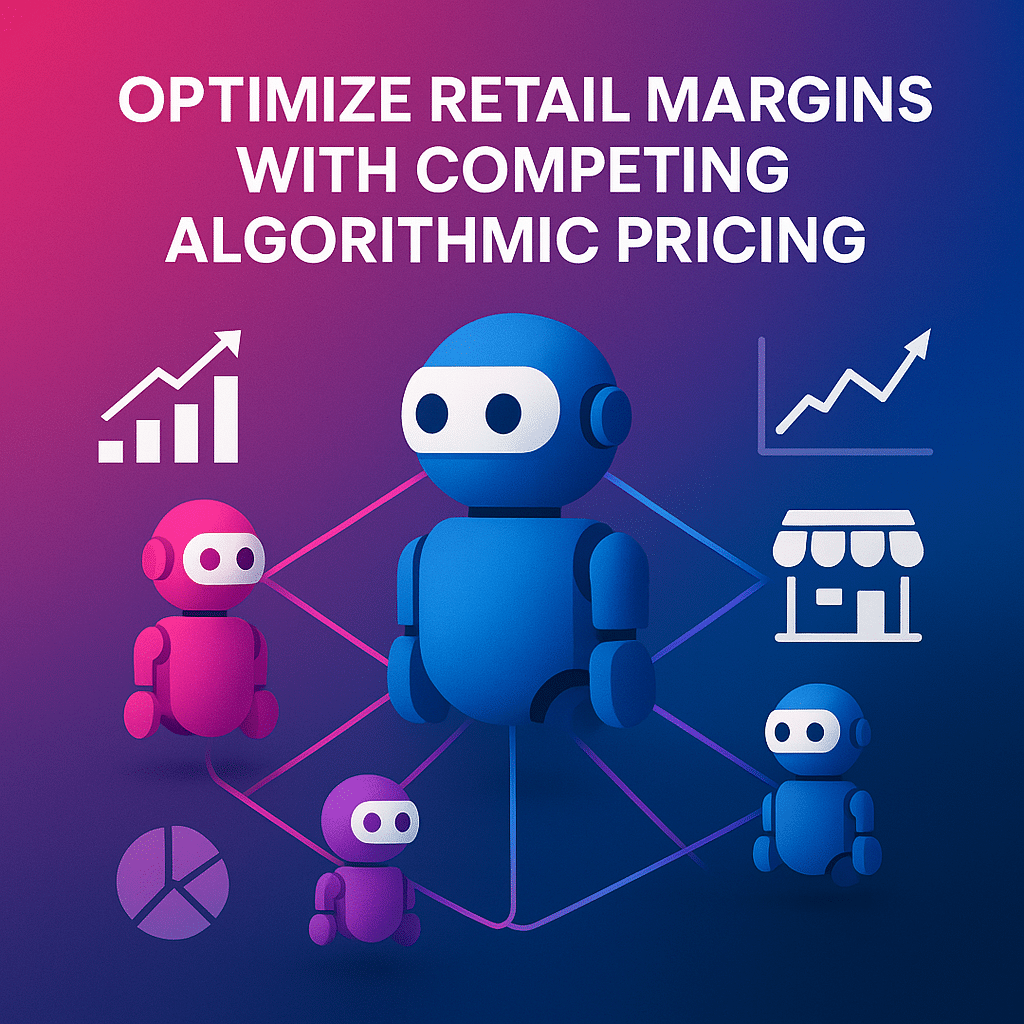
In a multi-agent pricing model, each algorithm (or agent) is designed to optimize a distinct pricing objective. These agents operate simultaneously, interpreting the same market data through different lenses. A coordination mechanism then reconciles their recommendations into a final price.
Consider a pricing decision for a popular electronics item. The system might include:
– A margin maximizer agent recommending a 7 percent price increase
– A volume optimizer agent warning of a 12 percent drop in demand
– A customer satisfaction agent flagging potential NPS impact
– A competitive pricing AI agent noting that two major rivals are holding prices
– A promotional alignment agent suggesting a temporary hold due to an upcoming campaign
Instead of averaging these inputs, the coordination layer weighs them based on business priorities, current inventory, and market dynamics. The result might be a 3 percent increase,balancing margin opportunity with volume risk and customer loyalty.
This pricing algorithm tradeoff approach mirrors how experienced merchants think. It surfaces the tensions behind each decision and enables more nuanced, data-driven outcomes.
BENEFITS OF COMPETING ALGORITHMIC PRICING IN RETAIL
Retailers that implement competing algorithmic pricing systems report significant gains across key performance indicators. Benefits include:
– 25 to 35 percent improvement in pricing efficiency
– 8 to 12 percent higher margins during competitive pricing pressure
– 15 to 20 percent reduction in margin erosion from blunt promotions
– 30 to 40 percent faster response to market changes
These gains stem from the system’s ability to adapt dynamically, balance tradeoffs, and avoid the pitfalls of rigid rule-based pricing.
A Fortune 500 electronics retailer implemented a multi-agent pricing system across 40,000 SKUs. The system included agents focused on margin, volume, customer loyalty, and competitor pricing. Instead of chasing every competitor price drop, the system used demand-aware pricing intelligence to identify when to hold firm and when to respond. The result: a 31 percent improvement in pricing efficiency and a 9 percent increase in market share.
IMPLEMENTING A COMPETING ALGORITHMIC PRICING STRATEGY
Retailers looking to adopt this strategy should follow a structured approach:
1. Define Agent Objectives: Start by identifying the key pricing goals relevant to your business. Common agents include margin maximization, volume growth, competitive alignment, inventory clearance, and customer loyalty.
2. Build or Source Agent Models: Develop specialized pricing algorithms for each objective. These can be built in-house or sourced from AI solution providers.
3. Design a Coordination Mechanism: Create a system that reconciles agent recommendations. Options include weighted scoring, bidding systems, or meta-learning agents that learn which agent to trust in different contexts.
4. Ensure Data Consistency: All agents must operate on a shared, real-time view of pricing, inventory, sales, and competitor data.
5. Integrate Human Oversight: Merchants should review and approve pricing recommendations, especially during early deployment. Over time, trust in the system will reduce manual intervention.
6. Pilot and Scale: Start with a high-impact category, measure results, and scale across the assortment.
COMMON MISTAKES TO AVOID
While the benefits are compelling, several pitfalls can derail implementation:
– Using agents with overlapping objectives, which leads to redundant recommendations
– Relying on simple voting mechanisms that produce bland compromises
– Ignoring the need for real-time, shared data across agents
– Failing to align agent goals with actual business KPIs
– Skipping merchant involvement, leading to low trust and adoption
Avoiding these mistakes ensures that the system delivers on its promise of strategic pricing coordination.
REAL-WORLD APPLICATIONS ACROSS RETAIL CATEGORIES
Competing algorithmic pricing is already delivering results across diverse retail sectors:
Fashion: A leading apparel brand uses multi-agent pricing to balance full-price sell-through with markdown risk. One agent pushes for higher prices on trend items, while another advocates early markdowns on slow movers. The system improved full-price sell-through by 8 percent and reduced end-of-season clearance by 15 percent.
Grocery: A top U.S. chain implemented competing pricing algorithms in perishables. One agent optimizes for spoilage reduction, another for basket profitability, and a third for competitive positioning. The system adjusts prices hourly based on real-time sales velocity, reducing waste by 18 percent while maintaining margin.
Beauty: A major cosmetics retailer uses pricing agents to balance online and in-store pricing. One agent focuses on shipping cost efficiency, another on customer experience, and a third on inventory turnover. The system improved online order fill rates by 9 percentage points and reduced inventory costs by 14 percent.
Home Improvement: A national retailer deployed pricing agents for seasonal items. One agent tracks category momentum, another monitors competitor promotions, and a third aligns pricing with inventory levels. The result was a 22 to 28 percent improvement in promotional ROI.
FUTURE TRENDS AND STRATEGIC IMPLICATIONS
The future of pricing is not about building a single perfect model. It is about orchestrating diverse perspectives to adapt to change. As AI pricing coordination matures, we will see:
– Cross-functional integration with inventory and promotion systems
– Real-time coordination with supplier pricing and cost changes
– Game-theoretic pricing strategies that anticipate competitor moves
– Meta-agent systems that learn which pricing agents to trust in different market conditions
Retailers that invest in these capabilities now will build a strategic moat. They will be able to respond faster, price smarter, and protect margins even in volatile markets.
CONCLUSION
Competing algorithmic pricing is more than a technical innovation. It is a strategic capability that enables retailers to optimize margins, adapt to market shifts, and make smarter pricing decisions. By deploying multi-agent pricing models that surface and resolve dynamic pricing conflicts, retailers can move beyond siloed decision-making and toward coordinated, intelligent pricing systems.
The retailers who lead in this space will not be those with the most data, but those with the best systems for turning data into decisions. Competing algorithmic pricing is that system. The time to build it is now.
KEY TAKEAWAYS
– Competing algorithmic pricing uses multiple AI agents with different goals to make smarter pricing decisions
– It resolves pricing algorithm tradeoffs by surfacing and negotiating between conflicting objectives
– Retailers see 25 to 35 percent improvements in pricing efficiency and margin performance
– Multi-agent pricing models adapt faster to market changes than single-objective systems
– Real-world applications span fashion, grocery, beauty, electronics, and home improvement
– Implementation requires clear agent objectives, shared data, and merchant oversight
– The future of pricing lies in strategic coordination, not isolated optimization
FREQUENTLY ASKED QUESTIONS
Q1: What is competing algorithmic pricing?
A1: Competing algorithmic pricing is a strategy where multiple AI agents with different pricing objectives negotiate to determine optimal prices, balancing tradeoffs like margin, volume, and customer loyalty.
Q2: How does it differ from traditional pricing models?
A2: Traditional models optimize a single goal, often missing broader impacts. Competing algorithmic pricing uses multiple perspectives to surface dynamic pricing conflicts and make more balanced decisions.
Q3: What are the benefits of using competing algorithmic pricing?
A3: Benefits include improved pricing efficiency, higher margins, faster adaptation to market changes, and better alignment with business goals.
Q4: Can this strategy be used in all retail categories?
A4: Yes, it is effective across fashion, grocery, beauty, electronics, and more, especially in categories with complex pricing dynamics and multiple success metrics.
Q5: What kind of data is required for implementation?
A5: Real-time, consistent data on inventory, sales, pricing, and competitor actions is essential for all agents to operate effectively.
Q6: How long does it take to see results?
A6: Retailers often see measurable improvements within 3 to 6 months of piloting, with full ROI realized in 12 to 18 months.
Q7: Do merchants still play a role in pricing decisions?
A7: Absolutely. Human oversight is critical, especially early on. Over time, as trust in the system grows, merchant intervention decreases.