
.svg)
Key takeaways
If you search google with "efficiency" and "effectiveness", in the number of results, effectiveness scores half of the efficiency.
Before we get into how efficiency and effectiveness are related to fashion, we will have a quick look at what do they mean.
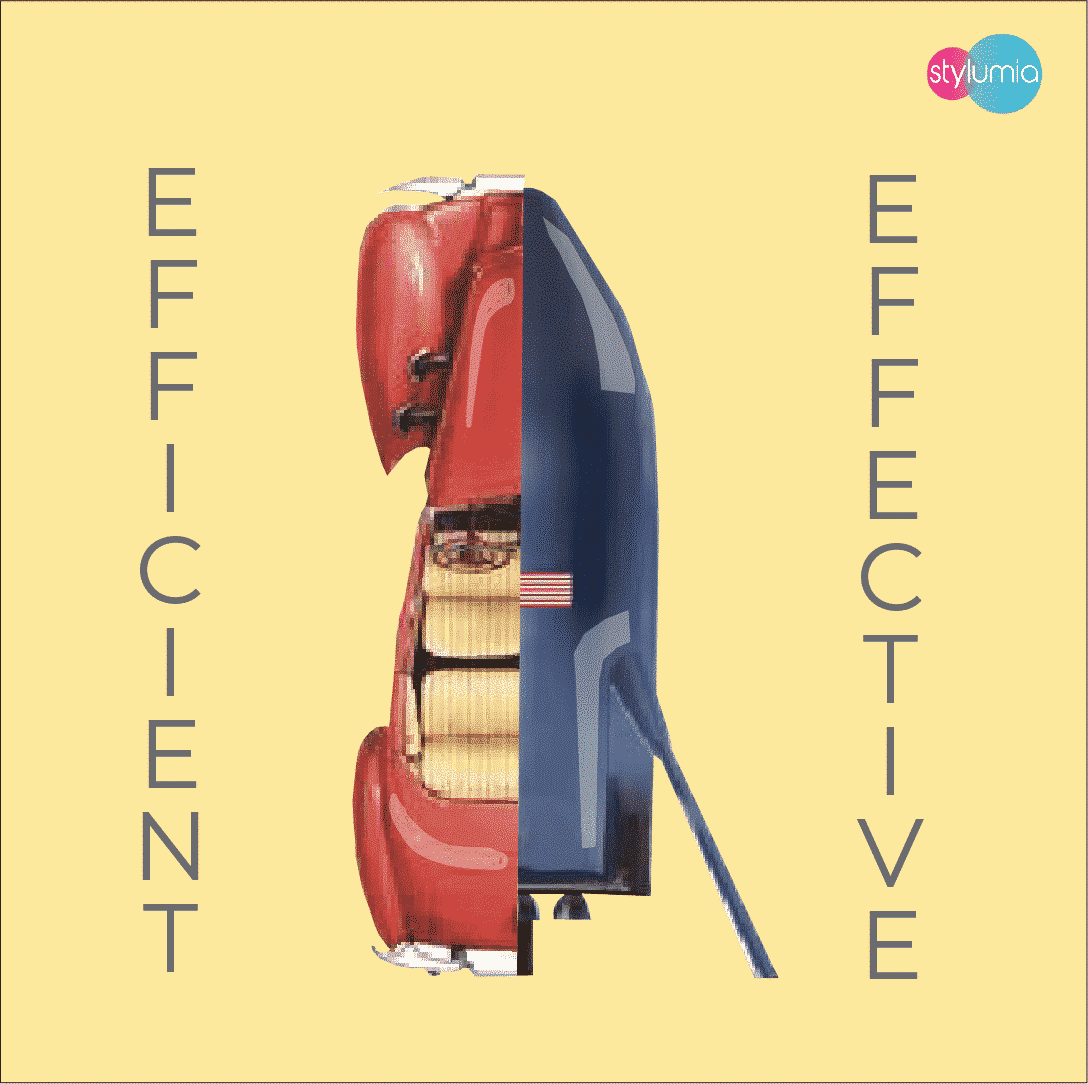
In Peter Drucker's words, Efficiency is doing things right, Effectiveness is doing the right things
Henry Ford supposedly said, "If I had asked people what they wanted, they would have said: FASTER HORSES..." (there are still debates on whether Ford said it, we will just take the merit of the quote).
The faster horse is in the efficient direction, the Automobile is in the effective direction. One can extend this to TESLA's sustainable ways for a human to move.
Fashion's Efficiency Past
As a first step, while we answer the question of Efficient Fashion or Effective Fashion? we start with the efficiency movement.
The fashion industry has been making products for decades using the same process of research, create, finalize, and deliver ranges to consumers. As more people use the process, the process becomes standard and the movement continued.
This includes tools and processes.
Any process is effective when there is a significant change in waste generation. In this webinar we conducted, we addressed exponential possibilities in fashion.
If we look at the data point of wastage generated by fashion, we are not in any way a transformational path. As per this Sharecloth's article, out of 150 billion garments made in a year, 1/3rd of 150 billion garments made in a year is never sold and another 1/3rd is sold at discount. This is leaving a huge wastage of economic resources and also leaves the planet unsustainable.
Fashion's Effectiveness Movement
This is the problem we at Stylumia were grappling with, in 2015. When we looked at the process, the way fashion product creation was done to meet future demand, we realized most of the existing processes and tools were designed with assumptions that were not relevant then.
We are in a continuously evolving, dynamic, digital world. We are trying to go to the moon with automobiles. This challenge needs new thinking and new technology that brings kinetic energy to the fashion business.
A quick look at kinetic energy from physics,
Kinetic Energy = 1/2 * m * v^2
The digital world needs fashion brands and retailers to build kinetic energy in their business which gets amplified by a square of velocity.
Many are mistaking velocity for speed. Velocity is the speed with direction (vector). The right direction is towards consumers. Most of today's processes are not aligned to consumers (though we may think it is), otherwise the world would not be accumulating so much waste year after year. There is a challenge here tracking moving consumer tastes over time relevant to a business. This is further challenged by the frequency of change.
We need a different mechanism to crank the new fashion flywheel.
If something has not worked for years, we need a phase change. That led to the need for a dynamic demand science that keeps the brand closer to consumers always. We need a different fuel to power this new engine.
Creation of Demand Science
This new need led to the creation of Demand Science® by Stylumia. We power fashion creation and supply engines of our customers by this proprietary demand science. We have seen the kinetic energy and the force multiplier coming in for their businesses.
The evidence is in seeing exponential results with our customers. Right from Fortune 100 retailers to medium science brands adopt our solutions. You can hear it from our customers here.
We are on a journey of making a difference eliminating waste by removing guesswork at a global scale and a lot needs to be done. We are learning by the way and thanks to everyone along the journey of placing trust, applying, and reaping benefits.
Those who started early have readied themselves on digitally transforming their business from creation to delivery and are facing the covid19 challenge exponentially better than their peers. This is what effectiveness does to your business, takes you to a different orbit.
Yes, that does take some effort to do that was never done before. Without that leap, we will remain in the incrementalism space.
These are not the times to get 100% alignment, then you are not innovating.
If you want to be 100% sure, you will be 100% late
If you would like to explore and find more about demand science, how it works, how it can help your business build kinetic energy, schedule a meet with us here.

.jpg)
.jpg)