
.svg)
Key takeaways
Introduction: From Strategy to Stalemate
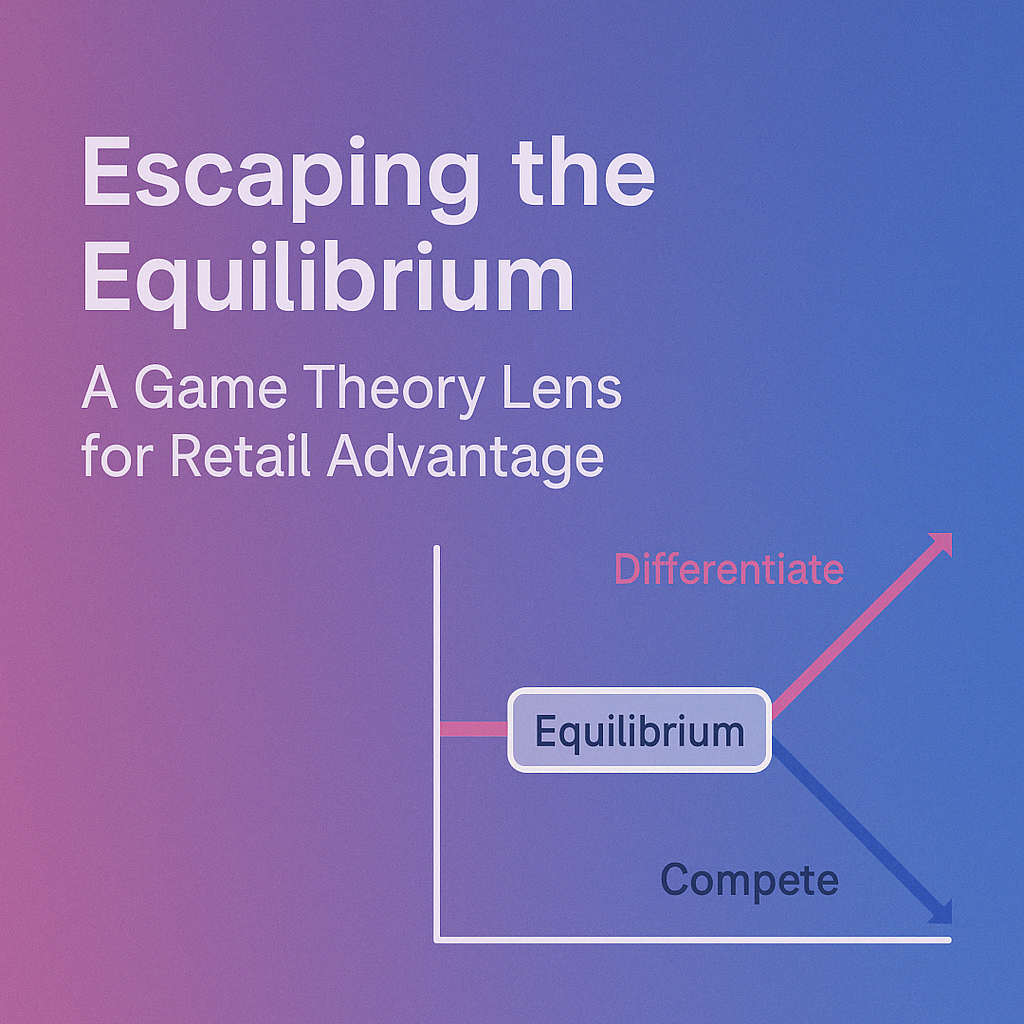
In today’s fast-paced and competitive retail world, many brands find themselves locked in repetitive cycles—price wars, trend mimicry, overlapping product lines—constantly reacting to what competitors do. These patterns, while seemingly rational, often lead to diminishing returns. What’s less understood is that many of these situations are symptoms of a broader concept from game theory: Nash Equilibrium in retail strategy.
Understanding this concept can help retailers not only decode why the market behaves the way it does, but more importantly, show them how to escape the sameness and unlock exponential, demand-driven advantage.
Understanding Nash Equilibrium in Retail Strategy
Formalized by mathematician John Nash in 1950, Nash Equilibrium describes a strategic situation where no player can improve their outcome by changing their own strategy, provided others stick to theirs. In business, and especially retail, this translates into a state of competitive inertia: everyone is reacting optimally to everyone else, but no one is breaking new ground.
In this context, Nash Equilibrium in retail strategy represents a point of balance where no retailer has the incentive to unilaterally shift pricing, assortment, or promotions. It feels rational. It feels safe. But it can also lead to stagnation.
Where Retail Equilibrium Shows Up
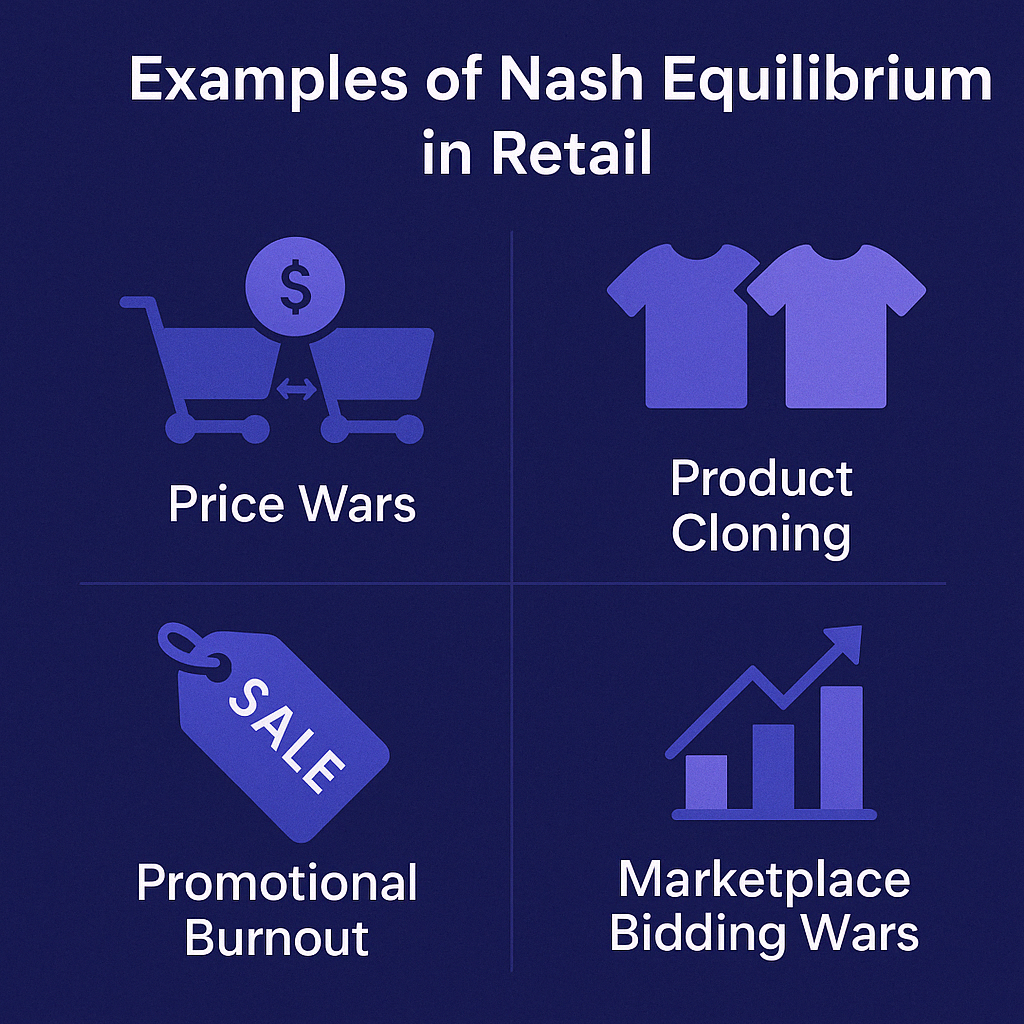
1. Price Wars
When retailers continuously undercut each other, the result is often a low-margin equilibrium. Everyone is discounting because no one wants to lose share. But no one wins sustainably.
2. Trend Mimicry
Fashion and lifestyle brands often mirror one another, following the same macro trends. The result? Overlapping assortments that offer little consumer delight or surprise.
3. Promotional Overkill
From Black Friday to End-of-Season Sales, the entire industry marches in lockstep. Opting out is risky. Joining in offers no edge. Retailers become stuck in a cycle of giving margin away.
4. Digital Platform Bidding
On e-commerce marketplaces, automated pricing tools adjust in response to competitors. The result is an automated race to the bottom, governed by an invisible equilibrium.
The Risk of Comfort in Equilibrium
The biggest danger of Nash Equilibrium in retail strategy is the illusion of smartness.
If every decision you make is a best response to what your competitors are doing, you might be making rational choices—but not transformative ones.
This kind of equilibrium:
• Commoditizes value.
• Trains consumers to expect less differentiation.
• Leaves businesses vulnerable to disruption.
Equilibrium is not growth. It’s defense.
Escaping the Equilibrium: Lead, Don’t Follow
Retailers looking to break out of strategic inertia need to redefine the game:
• Anchor strategy in real-time consumer demand, not competitor signals.
• Differentiate offerings based on whitespace, not just trend alignment.
• Act on foresight, not hindsight.
• Change the payoff structure to reward uniqueness over sameness.
Nature’s Analogy: Evolving Beyond Equilibrium
In biology, predator-prey systems often reach balance. But evolutionary leaps happen when one species adapts in a novel way, opening up new resources or advantages.
Retail ecosystems are no different. Staying in equilibrium is survival. Breaking it is growth.
Stylumia: Helping Brands and Retailers Move Ahead of the Market
Most market intelligence platforms help you monitor competitors. At Stylumia, we help you lead with differentiated insight.
We provide:
• Demand white space identification
• Trend forecasting anchored in purchase intent
• Competitive gaps based on actual consumer pull
• Personalized trend feeds tuned to each retailer’s market map
While others reinforce equilibrium, Stylumia helps you transcend it. You can go through the case studies here.
Why This Matters Now More Than Ever
In a world of AI agents, limitless choices, and shortened attention spans, sameness is silent failure.
Retailers that base strategy on consumer demand signals rather than competitive mimicry will:
• Avoid margin traps
• Create brand distinction
• Build profitable, lasting relationships with their customers
A Strategic Call to Action
If your decision-making rhythm sounds like “Let’s wait and see what others do,” you’re already late.
Let Stylumia show you how to:
• Sense shifts before they surface
• Identify high-value microtrends
• Position your brand where no one else is looking
Let’s escape the equilibrium together.
Reach out to Stylumia - Request a free consultation


.jpg)
.jpg)